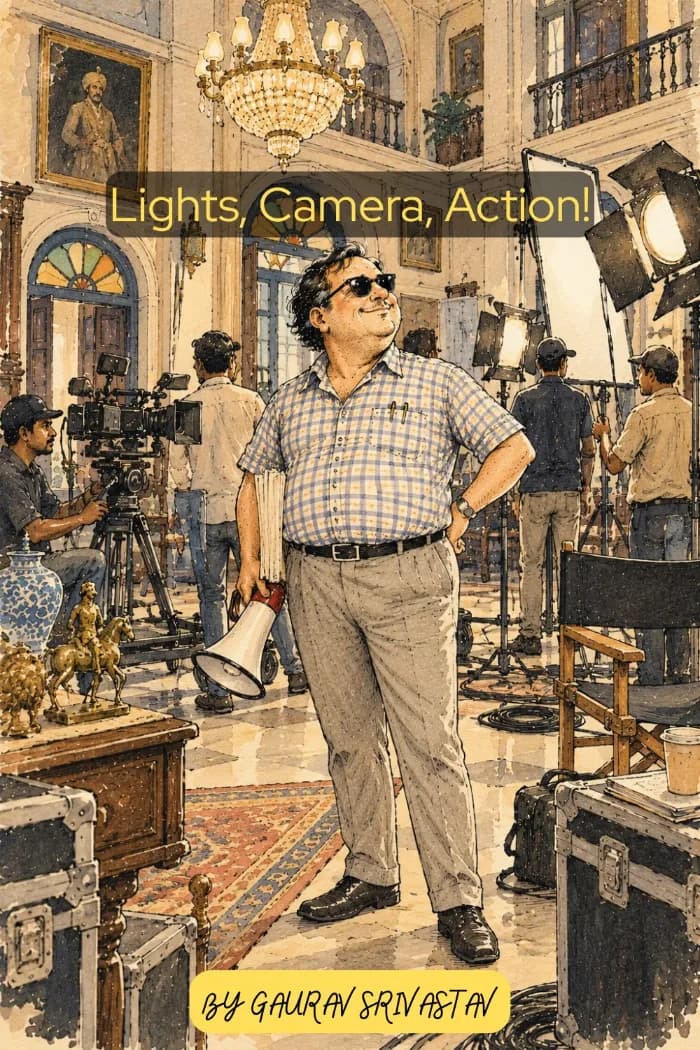
Gaba-Da And Lights Camera Action!
26 min read · 5,100 words · free · 1 view
What happens when a man with no money, no screenplay and absolutely no experience decides to make a blockbuster Bengali film? If you are Gobardhan Chatterjee, better known as Gaba-Da, you simply get on with it. Armed with an extraordinary talent for finding opportunities where ordinary people see obstacles, Gaba-Da has assembled everything a film producer could possibly need, apart from a story.
Gaba-da And Lights, Camera, Action!
I have noticed that the great catastrophes of history are seldom heralded by trumpets. They are heralded by silence. The hush before the avalanche, the stillness before the storm, and, in the particular case of my friend Gobardhan Chatterjee, known to the entire para as Gaba—da, a month in which nobody knocks on my door at six in the morning.
I became aware of it on the tram home from the press, wedged between a gentleman’s elbow and a basket of cauliflowers, somewhere around Hatibagan. It arrived suddenly, like a sneeze or a remembered debt. Thirty-one days. No borrowed tram fare, no lunch bill, no heavy hand on my shoulder introducing me to a stranger as “my partner in the enterprise.” For a month I had paid for my own tickets, eaten my own muri, and slept until seven. I had read the newspaper right through, including the shipping news, which nobody has done since the war. I ought to have been a happy man.
I was not. I have known Gaba-da since we were boys in the same para club, when he was already large, already sincere, and already owed the club secretary eleven rupees for a football that was never seen again, and the one thing I know for certain is that a quiet Gaba-da is a Gaba-da at work. Other men go silent when they are idle. Gaba-da goes silent when he is building. Somewhere in North Calcutta, I felt, a large man in dark glasses was assembling something, and the only open question was whose head the scaffolding would land on. I had a fair idea.
I got off at Shyambazar with the sensation of a man who has heard one boot drop upstairs and is waiting, with dread, for the other. Bhola, at the tea-stall at the mouth of our lane, handed me my evening cup without being asked and said, “Dinu-babu, your friend has not come. Four hundred rupees he owes me, and a whole month he has not come. It is not natural.” I said I had been thinking the same. “A man who owes money should come regularly,” said Bhola, with the gravity of a philosopher. “Otherwise how will the debt feel wanted?”
I drank my tea and walked up the lane to my rooms. I remember that I was whistling. I have often thought since that it was the last time I did.
My rooms are on the first floor of a house in a lane off Shyambazar: two rooms and a strip of balcony, rented from a Mrs. Mallick, a widow of firm views who lives below and believes in three things, Maa Kali, the rent, and the principle that any man who announces he is expected is expected. It is this third article of faith that accounts for the fact that, when I climbed the stairs that evening, I found my door unlocked and my light burning, and from within the unmistakable sound of a large body encountering furniture.
Gaba-da was pacing. He wore the checked Terylene shirt, tight across the stomach like a promise too large for its occasion, and the ancient dark glasses, which in the dimness of my sixty-watt bulb gave him the air of a blind man looking for something he had mislaid on purpose. He walked the length of my room with the rolling gait of a man late for an important meeting, which is no easy matter in a room eleven feet long. He struck the table. He struck the bed. He struck the almirah, which rocked on its feet and gave back a hollow note like a temple gong, and he said “Pardon” to it without breaking stride. On the bed lay my muri tin, open, scraped clean. On my pillow lay the cracked leather bag, curled up like a sleeping dog.
“Mrs. Mallick let me in,” he said, before I could speak. “I told her you were expecting me.”
“I was not.”
“A technicality, old fellow. In spirit you were. In every spirit that matters.” He waved me towards my own chair, as a host waves a latecomer. “Sit, sit. We have matters to discuss. I have been waiting four hours and I do not regret a minute, because I have employed them in thought.”
I observed that the almirah appeared to have been thinking too, judging by the dent. He ignored this. It is his gift that he can ignore anything, a dent, a debt, a dismissal, with the serene attention of a man watching a pleasant but unrelated parade.
“Dinu-bhai,” he said, lowering his voice, as he does when he wishes to be heard by the whole lane. “This is between us. Purely between us. I am sitting pretty.”
“You owe Bhola four hundred rupees.”
“A temporary matter. By Thursday I shall be in a position to purchase Bhola.” He drew himself up, and the bush-shirt, which had been holding its breath for some time, let out a button’s worth of it. “You are looking, old fellow, at a producer and director.”
“Of what?”
“Of a film.” He said it as though it had been his profession since boyhood and had merely slipped his mind to mention. “A full-length Bengali picture, which will, I say this with all humility, make Ray look like an amateur. And do you know what I have?” One thick finger went up. “A hero.” A second. “A location in which to shoot the entire film. No studio rent, Dinu, not one paisa.” A third. “A heroine.” A fourth. “Every camera, light, reflector and cable that a picture requires. And,” he paused, and the thumb came up like a conjuror producing the dove, “a big-time distributor of movies. A personal acquaintance. He has seen the file.”
He patted the bag. It gave back the dull note of a thing with nothing in it. I did not point out that nobody, to my knowledge, had ever seen the file, including its owner. I asked instead for the distributor’s name. “A gentleman of the highest standing,” said Gaba-da. “He prefers not to be named until the picture is cut.” I asked whether he had been shown anything that could be cut. “In spirit,” said Gaba-da.
He was walking again now, warming to it, and the furniture was suffering accordingly. Money, he said, was a matter of arithmetic. Hero, free. Location, free. Heroine and equipment, free. A film costs what it costs only if you are fool enough to pay for things, and he had never been that kind of fool. “Add up what I have saved, Dinu. Add it up!” I did the sum privately, on the ceiling, and found that on this reasoning he had saved something over four lakhs without spending a paisa, which is the sort of economy that governments dream of.
“There is lakhs in it,” said Gaba-da softly. “Lakhs, I tell you.”
I should like it on record that I did not believe him. But he was so happy. He stood in the middle of my room in his dark glasses, glowing like a lamp in a fog, and for a moment the whole thing sounded rosy. A man who has paid his own tram fare for thirty-one days feels, I find, a certain dullness settle on the world, and something in me, the part that was secretly bored of being sensible, leaned forward in the chair.
“Go on,” I said. That, as I have since had cause to reflect, was my first mistake.
It came out in pieces, as these things do. I give it as I pieced it together, since Gaba-da’s own version took the form of a military campaign, and I have too much respect for the language to reproduce it.
The hero was a young man named Shuvo Roy Chowdhury, the only son of a vast, pillared, perfectly preserved haveli in a lane near Chitpur, one of those houses that stand in the middle of the modern city like an old gentleman in a cinema queue, bewildered but unmoved. It had a courtyard with a tulsi-mancha, a staircase built, as Gaba-da put it, for a heroine’s entrance, and a chandelier that nobody had dared to switch on since the death of the late Roy Chowdhury. Gaba-da had gone there the previous Tuesday on an unrelated errand, collecting subscriptions for a Puja committee that, I happen to know, had not asked him to collect any, and had been met on the steps by Shuvo, who is twenty-eight, shy, and in possession of a profile.
“Roy Chowdhury Mahashay,” Gaba-da had said, removing nothing, “has anyone ever told you what the camera would do with that jawline?”
Nobody had. Nobody, as far as I could gather, had ever told Shuvo anything about his jawline, and he received the news like a man informed that he has inherited a province. By teatime he was the hero. By dinner the haveli was the location. “It comes free, of course,” said Gaba-da. “As part of the hero. It would be vulgar to charge a hero for his own house.”
The heroine was another matter, and I will say at once that Gaba-da had less to do with her than he now supposed.
Datta Cine Supplies stands on Dharmatala Street, between a dealer in second-hand radios and a shop that sells nothing but rubber stamps, and it belongs to a stout, careful man named Debangshu Datta, who has the face of one who has never been fooled twice. Gaba-da had gone in on the Wednesday to enquire about hire rates, purely for the pleasure of looking like a man who enquired, and in the course of enquiring, as is his habit, he had said too much. He had mentioned his forthcoming production. He had mentioned, with a flourish, that the hero was settled and the location was a haveli of the first quality. He had not mentioned a heroine, since it had not yet occurred to him that films have them.
Mr. Datta, it emerged, had been listening with the stillness of a man hearing a long-awaited knock. For eleven years, since she was fifteen, his daughter Tanu had been asking him, at breakfast, at dinner, and on one memorable occasion during a power cut, to help her become a heroine. She had asked kindly and she had asked furiously. She had performed for him, in the sitting-room, the entire death scene from a film he had not allowed her to see. And Debangshu Datta, who knew everyone in the picture business from the fringes inward, and who knew precisely what a hero and a haveli cost to find, understood on the instant that here at last, in a checked bush-shirt, was a man who had them.
“Chatterjee Babu,” he said, folding his hands on the counter, “I will give you every item of equipment in this shop. Camera, lights, reflectors, cable, the lot. Free. On one condition. My daughter is the heroine.”
Gaba-da, by his own account, considered the offer for some time. By mine, he accepted before the sentence had finished, pausing only to look as though he had weighed it. Tanu, summoned from the back room, where she had evidently been standing behind the curtain for the duration, appeared with the face of a girl who has heard, after eleven years, a door open in a wall she had been leaning on.
“You see?” said Gaba-da to me, thumbs in his belt, in the middle of my own room. “Strategy.”
I did see. That was the dreadful thing.
“And the story?” I said.
“Which story?”
“The story of the film, Gaba-da. What happens in it.”
He took off the dark glasses, a rare event, like an eclipse, and regarded me with eyes that were small and mild and full of trust, like a calf’s. Then he put them back on.
“The vision,” he said carefully, “is complete. The story is merely a formality.”
There was a silence. In it I heard Mrs. Mallick downstairs scolding a cat, and a tram going by at the end of the lane, and the whole venture coming apart in my head like a wet cardboard box. There was no screenplay. There was no outline. There was no idea, not even a bad one. There was a haveli, a jawline, a girl with a father, and a shop’s worth of equipment, all waiting politely, like guests at a wedding where the bridegroom has not yet been informed, for something to happen to them.
“Everything else is done,” said Gaba-da gently. “One small item remains. A story. A man of your education could write it in an evening.”
He turned to me with that look of tender confidence that I have learned to dread more than his rage. “Which is exactly why, Dinu-bhai,” he said, “I thought of you.”
I protested for forty minutes, with examples. I pointed out that I was a sub-editor, that my sole creative output was the correction of other men’s spelling, and that a film was not a thing one wrote on a Tuesday. I cited Ray, who wrote his own. I cited the laws of probability. Gaba-da listened with a wounded patience, nodding at intervals, as a doctor nods at a patient describing the symptoms of a disease he has already decided is not serious. Then I agreed.
I should like to explain why. Partly it was affection, though I would sooner chew glass than say so to his face. Partly it was the foolish hope that the man’s luck must turn some day, and that I wanted to be standing near it when it did. And partly, and I confess this here and nowhere else, it was that nobody had ever asked me to write anything. For twelve years I had been trimming other people’s sentences and giving other people’s headlines their full stops, and here was a man, however unreliable, who believed I could make something up out of nothing.
But as I saw him down the stairs he let me pay his tram fare without a flicker, and I stood on the landing with the cold premonition of a man who has signed something without reading it. Bad things were coming. I could hear them coming, like a tram with a faulty bell. I went back in and found he had eaten the last of my biscuits too.
I began on the Monday. I had settled the terms with myself in advance: I would come home from the press, wash, eat, and write for two hours at the table by the window, under the sixty-watt bulb, and by the end of the week I should have a story. It seems to me now a perfectly reasonable plan. I mention it only to show how far a sensible man may be undone by a system.
The system was that Gaba-da arrived every evening at eight, with someone.
On the first evening it was Shuvo. He stood in my doorway with one hand against the frame and the profile turned to the landing, while Gaba-da announced, “Dinu-bhai, the hero. He has thoughts.” He had. His hero was a zamindar. Brooding. Tragic, but secretly rich. “And there should be a song, Dinu-babu. In the rain. With the jawline in profile.” I asked what the zamindar was brooding about. He thought for some time. “His jawline,” he said at last, “has been misunderstood.” He stayed until eleven, seated on my bed with the air of a man being photographed, and when Mrs. Mallick came up with the milk and took in a strange young man, his cheekbones and my bed, she said nothing, in a manner I expect to hear again on my deathbed.
On the second evening it was Tanu, with a lens cap in her hand like a talisman. She was twenty-six, quick and dangerous, and eleven years of rehearsal had given her views on everything. She heard about the song and killed it in a sentence. Her heroine did not sing, did not wait to be rescued, and would not be a damsel. She wanted a woman who leaves. “Where does she go?” I asked. “Away,” said Tanu. “That is the whole point.” At ten o’clock there was a heavy tread on the stairs and Mr. Datta appeared in the doorway, having, he said, been passing. Nobody passes my door. He took the only chair, folded his arms like a man guarding a sleeping relative, and informed the room, with a long look at the bed, the single window and the muri tin, that his daughter was to be respectable at all times. No scene that could embarrass the family. No rain, he added darkly, in view of what rain does to saris. Gaba-da had to explain to Mrs. Mallick on the stairs that the young lady was a heroine, which did not, I gathered from the silence, improve matters.
The third evening was Ma. A lady of the Roy Chowdhury household does not visit a sub-editor, and so I can only report that she did, in a starched sari, with a driver who remained at the foot of the stairs like a sentry. Gaba-da had escorted her, purely out of courtesy. She sat on the one chair and looked at my room as a museum guide looks at an exhibit she disapproves of. The haveli, she said, must be shown with dignity. The family must be shown as noble. “And my son does not play a drunkard. Ever. Nor a debtor. Nor anyone who is rescued by a girl.” Then her eye fell on a lens cap lying on my pillow, left there the evening before, and she picked it up, turned it over, and set it down without a word, with the gentleness of a woman closing a case. I have never been so thoroughly convicted of something I had not done.
The fourth was Digant Babu, the cameraman, whom Gaba-da had found I never learned where: a thin old gentleman in a safari suit the colour of weak tea, who had spent forty years on the fringes of Tollywood holding other people’s reflectors and was therefore the only person who had ever been part of a film. He sat on my bed. “I worked under the great ones,” he said. “I will tell you what a picture needs, my boy. A dream sequence. A thunderstorm. And a long close-up of the heroine’s eyes, as in the old days.” He then described the old days, at length, and somewhere in the second reel of them he fell asleep sitting up, hands folded, with the stillness of a man in a long-established hide. Gaba-da laid a finger on his lips. “Do not wake the master,” he whispered, and for an hour I wrote with a sleeping cameraman at my back and Gaba-da quietly finishing my biscuits. At eleven Digant Babu opened one eye, said “Dream sequence,” and went home.
By the end of the week I had five opinions in my notebook, no two of which could share a page, and a draft that tried to give all of them what they wanted. The zamindar, brooding but without debts, acquired a twin brother to hold the debts. The heroine left, returned, and left again in the first, second and fourth reels. A mother was added for dignity and removed for being too dignified. Mrs. Mallick, who sleeps directly below and has views, tapped her ceiling with a broom at half past one each night, to switch off the lights, which I understood to be a form of editorial comment. I began to dream in Digant Babu’s thunderstorm.
At the press, the chief sub-editor took me aside, between the proofs and the tea, and asked, with delicacy, whether I was unwell. He had cause. The previous morning a headline of mine had read MINISTER INAUGURATES BRIDGE, WEEPS IN RAIN, and the bridge, I recalled, had not been opened in any weather at all. “Dinu,” he said, “I do not ask what it is. But whatever it is, I would stop.”
Gaba-da, whom I consulted for guidance, read one page of the draft standing up, in the gloom, with his dark glasses on, which cannot have helped, and handed it back with a very serious face. “Promising,” he said. “More lakhs.”
On the Wednesday he announced that we were going to Baghbazar. “The distributor, Dinu-bhai. It is time to bring him on board.”
I had come to think of the distributor as a figure of speech, like the Loch Ness monster, but he turned out to exist. His name was Mr. Bhaduri, he owned a small circuit of cinema halls, and he played carom with Chhoto-mama every Saturday evening. Gaba-da’s personal acquaintance with him consisted of having once been handed a plate beside him at a wedding. This explained why he preferred not to be named. It was Chhoto-mama who would have to be asked for an introduction.
Chhoto-mama is a retired railway officer with the face of a man who has spent thirty years announcing delays. He heard us out in a cane chair beneath a framed photograph of a locomotive. Gaba-da made his pitch with great warmth. No money was wanted, he said, not a paisa. Only a word with Bhaduri-babu, a formality, a small push to a door already open.
When it was over, Chhoto-mama spoke. He has a flat, official voice, and each question arrived like a train at a station nobody had built.
“What is the film about?”
“The vision,” said Gaba-da, “is complete.”
“I did not ask about the vision. I asked about the film.”
There was a pause.
“Who is directing?”
“I am.”
“What have you directed?”
“Everyone has to begin, Chhoto-mama. Satyajit Ray began.”
“Ray had a story. Who is writing yours?”
“Dinu.”
Chhoto-mama turned his eyes upon me. I studied the locomotive. “And the budget?”
“Nil. Everything is free. The hero, the haveli, the heroine, the equipment.”
“Free from whom?”
Gaba-da opened his mouth, and for the first time in my experience nothing came out of it. “And what,” said Chhoto-mama gently, “has Bhaduri seen?”
“The file.”
“Which file?”
Gaba-da patted the bag. The bag, as ever, said nothing. “In spirit,” he said at last, but without his usual conviction, like a man speaking a language he is beginning to forget.
Chhoto-mama sat quiet for some time. “Gobardhan,” he said, “I will not put my name to an empty bag. When you have a story, finished, on paper, with an ending, bring it to me, and I will ring Bhaduri myself. Until then I will not trouble a friend on a Saturday.” He sighed, a sigh that rattled the window, and added the usual remark, “Ei chele-ta ke niye ar ki hobe.” At the door he caught my sleeve. “Dinu. You are a sensible boy. Keep an eye.” I said I would. We both knew what that was worth.
On the way down the steps Gaba-da said nothing for two whole minutes, which is a record. Then he put a hand on my shoulder. “A man of the old school, Dinu-bhai,” he said kindly. “He does not see the possibilities.”
The Sunday came on a hot, still afternoon, the kind on which the air sits on the chest like a cat, and the haveli’s great hall had been got up like a wedding. The hero had brought the venue. The heroine, by way of her father, had brought the snacks: singaras, kochuris and rasgullas from the best shop in Dharmatala, and tea in brass flasks, all of it paid for by Mr. Datta, who mentioned the expense twice, to Ma, who noticed. The producer had brought himself and his dark glasses. He sat at the head of the hall in the good crease, looking like a maharaja who has never lost a war. The chandelier, for the first time in living memory, had been switched on, and it hung over us with a quiet, hissing menace, like a thing that remembered better days and did not hold us responsible for them.
They were all there. Shuvo in a fresh kurta, jaw forward. Tanu with a notebook on her knee. Ma in the front row with the air of a judge about to enjoy herself. Mr. Datta beside a camera case he had carried in personally. And Digant Babu, who had brought a folding stool of his own and sat on it with great stillness.
I stood, with thirty-one pages and a throat like sandpaper, and read. I had built the thing, after a week of agony, like a bridge, with every pier set under somebody’s complaint, and I thought, God help me, that it was rather clever. It lasted four minutes.
Shuvo objected first: the hero was not brooding enough; on page three he had smiled. Tanu said the heroine in the third reel was still waiting at a window for someone to come, and what was that if not rescue? Ma rose to say that the word “debts” appeared on page nine and she would not hear it in her late husband’s hall. Mr. Datta observed that the heroine was given an age in the dialogue, and an age was a number, and a number was not respectable. And Digant Babu said quietly that he had read the whole thing twice and could not find a thunderstorm in the second act.
Within five minutes the hall had split into five camps, each demanding that the story be told in its own manner, and nobody prepared to yield an inch. Ma shouted at Shuvo, who at Tanu, who shouted back and then at her father, who shouted at the very idea of rain, while Digant Babu repeated “thunderstorm” at intervals, like a man at a séance. The chandelier trembled.
Gaba-da rose. I will say this for him: he tried. “Gentlemen. Ma. Miss Datta. Let us be reasonable.” He turned to Shuvo. “Roy Chowdhury Mahashay, a hero is permitted one smile in a picture. Raj Kapoor smiled in every frame.” To Tanu: “Miss Datta, a woman who leaves must first be a woman who stays. That is Art.” To Ma: “Debts, Ma, is a purely technical word.” To Mr. Datta: “An age, Datta-babu, is merely a number,” which was exactly what Mr. Datta had objected to. To Digant Babu: “A thunderstorm may be implied.” Each remark landed on its target like a lit match on a haystack.
And as he spoke, I watched his face. I saw him look from one to the next, five people and five films, and the dark glasses slid a little down his nose, and I saw a thought cross his face. It was the thought that this was a great deal of work. I watched it arrive. I watched him look at it, and put it away. He did not say it. He never says it. He would sooner be struck by lightning.
Shuvo quit first. He rose in the middle of Ma’s sentence, drew himself to his full height, which was not very full, and announced that he refused to be a side character in his own haveli. He then walked out, profile at an angle, and slammed a door which, the hall being what it is, took four seconds to arrive.
Tanu went second. She shut her notebook, said “I wanted a woman who leaves,” in a voice that carried to the back row, and, with a certain grim consistency, left. Her father followed, bearing the remaining singaras before him on their brass tray, like a man salvaging evidence.
Digant Babu rose from his stool, folded it with care, and said mildly that he would be needing an advance. “Something in hand, Babu, before I can continue to work. A matter of principle. It was never discussed.” He tucked the stool under his arm and waited, in the hall of the Roy Chowdhurys, with the patient dignity of a man who has outlasted forty years of producers. When nothing came he nodded, as one who had expected it, and went.
Ma remained, alone in the front row, the one person present with nothing left to object to. She looked at the chandelier, then at me, and said with a terrible mildness, “Dinu-babu, Mr. Datta’s tea was cold,” and followed her son out in a rustle of starch.
The hall was empty. Vacant chairs. A great deal of echo. Gaba-da stood in the middle of it, under the hissing chandelier, and patted his bag, and found it, to his visible astonishment, empty.
He did not speak for a minute. I watched him gather himself, as a man gathers a coat that has fallen off a nail, and when he turned to me it was with enormous dignity.
“Dinu-bhai,” he said, “the film is temporarily paused for restructuring. A small technical difficulty.” He looked up at the chandelier. “The world has simply not yet understood my vision.”
“Thik achhe,” he said to the chandelier. “Thik achhe.”
He went out through the great doors and into the lane, and I followed, because I always follow, and at the gate he turned and looked at me and said nothing whatever about the bus, which is how I knew it was time to pay.
I paid. It is a curious feature of my life that I can state, to the paisa, what every one of Gaba-da’s disasters has cost me, and could not tell you what any of them has ever returned. Two rupees for the tram. Five for the muri. Eleven, years ago, to the club secretary, on behalf of a football. I counted the coins into his palm in the lane outside the haveli, under a sky going the colour of weak tea, while behind us the chandelier, still burning, threw its hissing light across an empty courtyard, as though the house had not quite understood that the picture was over and was waiting, with the patience of old buildings, for someone to say “Action.”
On the bus, wedged in beside him, I heard it begin under his breath, very softly, like a kettle: something about hilsa. A remarkable opportunity in hilsa. A buyer in Delhi. “Dinu-bhai,” he whispered, with the old light behind the dark glasses, “there is lakhs in it.”
I looked out of the window and said nothing. In my bag the thirty-one pages sat quietly, and I found I could not bring myself to throw them away. I had, God help me, already begun to think how the second act ought to have gone.
The end.
Comments
No comments yet. Yours can be the first.
About the author
Gaurav Srivastav
Gaurav Srivastav has worked in media and entertainment his entire career, and leads ASGV, a growth strategy consultancy. He has been reading P.G. Wodehouse since he was old enough to understand the joy of expressing in similes. It is to his mother’s side of the family, rooted in the Bengali culture, that he owes both this book's setting and most of the gossip in his Kolkata based humour stories. Rajbari Haveli is his first novel. Gaba-da Chronicles are short stories full of Kolkata para life.
More about Gaurav SrivastavFollow to hear when Gaurav Srivastav publishes their next story or book.
Enjoyed that story?
ARC readers wanted
Tick the ARC box and we'll email you new requests from authors looking for readers, on Fridays in weeks when there are some. Each author chooses who gets a copy. You'll get the Shout-Out too: four indie books in every issue.
You might also like
- 60 min
Between Silence and Stone
Andrew D Levine
Whimsical
- 10 min

Excerpt from "Pawn of the Demon Prince"
Charles Moffat
Funny
- 26 min
Silent Guardian
Sam Larson
Friendship
- 57 minFantasy
The Last Fortress
The Last Fortress
J. Solary
Friendship
- 11 minChildren's
Oliver the Wise Owl and the Secret of the Whispering Woods
Oliver the Wise Owl and the Secret of the Whispering Woods
Shivank
Feel-good
- 18 min

The Names the Lights forget
Matthew McConville
Morally grey