Something That Wasn't Ours
48 min read · 9,561 words · free · 6 views
Something That Wasn't Ours
By the time Winifred Cullen reached Big Sur, the fog had swallowed most of the Pacific.
She had been able to see it earlier, flashing silver between the bends in the highway, far enough below the road to make her grip the steering wheel more tightly than she cared to admit. Now there was only white beyond the passenger window and, on her left, the rising wall of the Santa Lucia Mountains, dark with trees and smelling of pine, damp earth, and something else she had noticed perhaps twenty miles back.
The little dog stood with his front paws braced on the passenger seat, nose lifted toward the open vent.
"Don't start," Winifred said.
He was a Yorkshire terrier, at least when there was no reason for him to be anything else, and he had perfected an expression of mild contempt that Winifred suspected was entirely his own. She had never known whether familiars acquired their personalities from the witches they accompanied or arrived with them fully formed. After six years with telepathic Batair, she had decided she preferred not to know.
"I smell it."
"That doesn't mean it's any of our business."
She had been invited to Big Sur to spend ten days with Margaret Bell, whom her mother had known for years and Winifred had met only twice. Margaret was sixty-three, knew more about medicinal plants than anyone Winifred had ever encountered, and had written in June to say that half the young people appearing on her doorstep seemed determined to poison themselves with plants they had identified from books written by other young people who didn't know what they were talking about.
If you're willing, Margaret had written, I could use another pair of hands.
Nothing about magic. Nothing about the Veil. Nothing about strange lights in the woods, voices without bodies, or any of the other things that tended to turn a simple visit into something Winifred had to explain to her husband afterward.
Ten days. She had packed for ten days.
Her sons were perfectly capable of surviving ten days without her, despite considerable evidence that none of the men in her household understood that a wet towel left on a bed did not eventually hang itself up. She had kissed them all goodbye, put Batair in the car, and headed west.
She intended to learn something from Margaret, make herself useful, see the Pacific Ocean, and go home.
Batair made a small sound in his throat.
"I said I smell it."
The scent wasn't unpleasant. That was what bothered her.
Pine and salt came through the vent, and beneath them something green and sweet, like grass after rain, although there had been no rain. Winifred knew that smell. Not precisely that smell—such things were never quite the same twice—but the sensation beneath it. A faint lifting along the skin of her arms. The awareness of being somewhere that was not entirely one place.
She had also learned that noticing a door was not the same thing as being invited through it.
"Behave yourself."
Batair sneezed.
"Exactly."
Margaret's directions ended with turn left at the mailbox with the blue bird painted on it, which would have been more useful if three separate mailboxes had not acquired blue birds.
Winifred chose the second and was wrong.
The road narrowed until it became little more than two dusty tracks between the trees. She found herself passing a battered Volkswagen bus painted with flowers, two tents, a clothesline strung with jeans, towels and something she sincerely hoped was supposed to be a shirt, and four barefoot people sitting around a scarred wooden table.
Winifred slowed, partly because she had begun to suspect she was once again going the wrong way and partly because there was no way to pass without putting at least one wheel into the brush. No one seemed concerned about the arrival of a strange car. A blond young man in faded jeans and no shirt lifted a hand in greeting, while one of the girls remained folded into her chair with both bare feet tucked beneath her skirt. The table between them held a large brown teapot, several mismatched cups, a bowl of rice and an open jar of peanut butter. Someone had left a half-eaten carrot beside an overflowing ashtray.
It looked less like a commune than the aftermath of a picnic nobody had quite finished cleaning up.
Batair climbed onto the passenger seat for a better look.
"Don't get excited," Winifred told him. "I don't see anything you'd eat."
The blond young man had come toward the car by then, smiling easily enough that Winifred rolled down her window. Up close, he was younger than she'd first thought, twenty-one or twenty-two at most, with sun-browned shoulders and hair that might have been very attractive if anyone had introduced it to a comb recently.
She asked for Margaret Bell.
"You passed her place. Back at the fork."
Winifred glanced into the rearview mirror at the road she'd just negotiated. "Of course I did."
That made him laugh, and one of the girls at the table looked over. "Is that Mrs. Cullen?"
Apparently, news traveled efficiently even without telephones.
Winifred turned farther in her seat. "It is."
The girl got up and came toward her, brushing crumbs from the front of her skirt. She was very young, perhaps nineteen, with long brown hair that reached nearly to her waist and a man's blue work shirt knotted loosely over a white cotton top. There were bluish shadows beneath her eyes and something unfocused about the way she looked at Winifred before noticing Batair and immediately declaring him beautiful. Batair accepted this as his due.
"His name is Batair."
The girl crouched beside the open window but, to her credit, didn't immediately reach through it to touch him. She asked if she could, and when Winifred told her to ask him, she looked uncertain whether this was a joke until Batair settled the matter himself by leaning toward her hand. He closed his eyes appreciatively while she scratched beneath his chin, apparently willing to forgive any number of human deficiencies in exchange for proper admiration.
"Rachel," the blond young man supplied from behind her, although by then Winifred had begun to suspect he wasn't especially necessary to the conversation. Rachel straightened and said Margaret had told them Winifred knew about plants. Quite a lot about plants, apparently, although Winifred corrected that to some. Margaret was being generous, and while that wasn't entirely true, Winifred had discovered long ago that announcing how much one knew was usually the quickest way to encounter something one didn't.
Behind Rachel, the other two young people had returned to whatever conversation Winifred had interrupted. The thin young man sitting cross-legged on the ground took a drag from a joint and passed it to the girl beside him, who accepted it without looking away from whatever she was saying. The sweet smoke drifted across the clearing, mingling with woodsmoke, crushed grass and the resinous scent of the trees. Something was cooking nearby as well, onions certainly, although whatever accompanied them had been simmering long enough to surrender its identity.
Rachel noticed Winifred noticing the joint and asked if she minded. Winifred couldn't imagine why she would, and said so. That produced another small hesitation, and Winifred was beginning to recognize them. The girl kept expecting to encounter the older woman she had already constructed in her mind and seemed mildly surprised each time Winifred failed to become her.
Rachel's assumption amused Winifred enough that she let it stand. She had no need to prove herself interesting to a nineteen-year-old. At nineteen, Winifred had regarded forty as an age at which people ceased having adventures and began discussing their digestion, an opinion she had revised considerably as forty approached. She was about to ask whether the second turn really did lead to Margaret's house when Batair shifted beneath her hand.
Anyone else might have missed it. Winifred didn't. His small body had gone perfectly still, the pleasure of Rachel's attention forgotten as he lifted his head toward the trees behind her. The change in him was enough to make Winifred look, although at first she saw nothing but the steep rise of the land beneath the redwoods, ferns massed between their trunks and patches of late-afternoon light that seemed almost unnaturally bright against the darkness beneath the canopy. Then the breeze changed, carrying the sweet smoke from the joint across the road along with onions, woodsmoke, warm earth and that other scent she had been following since before the fog came in.
Rachel must have seen something in her face because she turned toward the trees. "You feel it, don't you?"
Winifred didn't answer immediately. She wasn't sure feel was the word she would have chosen, although it was as good as any. The scent was part of it, but so was the faint prickling along her arms and the peculiar sensation that the distance between where she stood and somewhere else had become very small. She had known places like this before, places where the Veil wore thin enough that a hedge witch could sense what lay beyond it without making any effort to look. There was nothing inherently dangerous about them. A stream could be shallow without inviting anyone to drown in it.
"What do you feel?" she asked.
Rachel glanced over her shoulder at the others before moving a little closer to the car. "It's hard to explain. There's a place farther up where everything changes. The light looks different, even in the daytime, and sometimes you can hear things that aren't there."
"How do you know they aren't?"
The question surprised her. Winifred saw that immediately, but Rachel considered it rather than laughing. "Because nobody else hears them."
That wasn't proof of anything, particularly in Winifred's experience, but she kept that to herself. "Do you?"
"Sometimes." Rachel hesitated. "Joshua says I'm more receptive than most people."
The name was offered with enough expectation that Winifred gathered she was supposed to know who Joshua was. She didn't, and before she could ask, something moved between two of the redwoods.
It was there for no more than a second, pale against the enormous dark trunk, roughly the height of a child but much too slender. Winifred caught the suggestion of a face and the gleam of eyes before it withdrew. Batair's ears went forward, but the rest of him relaxed, which told her considerably more than the glimpse itself had.
The Fae were here. That explained the sweetness in the air and perhaps some of what Rachel had experienced, although Winifred doubted it explained all of it. The old ones could be curious, particularly when humans gathered noisily around places where the boundaries were already thin, but they rarely had much interest in being discovered. Human beings had spent centuries blaming them for every lost object, spoiled pail of milk and inconvenient pregnancy. Winifred couldn't entirely blame them for preferring the trees.
Rachel had gone quiet beside her. The others seemed not to notice. Nick was arguing with Daniel about whether there was enough rice for supper, one of the girls had begun cutting carrots on a scarred board balanced across her knees, and someone farther down the slope was attempting three chords on a guitar with more persistence than talent. It was an ordinary enough collection of young people making an ordinary amount of noise, but Rachel stood just outside it somehow, rubbing one thumb over the knuckle of the other hand.
"You thought I'd be older," Winifred said.
Rachel looked startled, then embarrassed. "Margaret said you knew about things."
"People generally acquire knowledge before they acquire wrinkles."
That earned a small laugh, which seemed to be what Rachel needed. She pushed her hair behind one ear and glanced toward the table, perhaps making certain no one was listening. "She said you helped her once. A long time ago."
Winifred waited. She had learned years before that silence, properly used, was considerably more effective than asking people what was wrong. Rachel looked down at Batair, who had settled himself beside Winifred's shoe with the air of a creature prepared to remain there until everyone else came to their senses. Beyond him, something moved between two redwoods where there was no wind at all, and Winifred felt the faint answering warmth of the ring against her hand. Whatever had taken an interest in this place had not left. It was listening too.
Rachel lowered herself onto the ground, gathering her skirt beneath her, and for a while seemed more interested in watching Daniel lose his argument over the rice than in explaining why she had asked Margaret Bell for help. Winifred let her watch. Eventually Rachel said, "Things started disappearing," in a tone suggesting she knew how unimpressive that sounded. A comb first, then a bracelet, one shoe; all of them had returned, although never where she had left them. The comb had been hanging from the branch of a tree well above her head, and the bracelet had turned up in Daniel's coffee cup. "He accused Nick. Nick accused everybody." She smiled at the memory, but the smile didn't last. "I thought it was funny too, then."
That then was what interested Winifred. People misplaced things, particularly people living communally in tents and cabins where ownership appeared to be regarded as a negotiable proposition, and young men had been putting women's belongings in ridiculous places without assistance from the Fae since considerably before Winifred was born. She might have dismissed the whole business as camp mischief if Rachel had not gone on rubbing that same knuckle with her thumb. "What changed?" she asked, and Rachel's hand finally became still. She looked past Winifred toward the trees before answering. "I started hearing someone call my name."
Winifred asked whether the voice belonged to a man or a woman, and Rachel frowned before admitting that she couldn't say. "When it happens, I know somebody said my name. I hear it perfectly. But afterward, when I try to remember what the voice sounded like, there's just nothing there." It had happened first at the creek while she was washing clothes, then on the path back from Margaret's, and finally two nights ago while she was asleep. That time she had awakened certain that someone was standing just beyond the tent, calling softly to her.
"And you went to see who it was?"
"I almost did." Rachel drew her knees up and wrapped her arms around them. She had been halfway out of her blankets before she was properly awake, and even then it hadn't occurred to her to be frightened. The voice had seemed familiar, although she couldn't have said whose it was, and for a few seconds she had been absolutely certain that whoever was waiting outside was someone she wanted to see. "I got all the way to the tent flap before I stopped."
Winifred glanced toward the trees again. Whatever she had sensed there remained faint enough that she could not tell whether it was one presence or several, much less what it wanted, but the distinction Rachel had just made mattered. Curiosity could draw a person out of bed; so could the conviction that a friend was calling. Neither required magic. The certainty that an unrecognizable voice belonged to someone beloved was another matter. "What made you stop?"
"I don't know." Rachel was quiet long enough for Nick's voice to rise above the conversation at the table, insisting that there would have been plenty of rice if Daniel hadn't eaten half of it before anyone else got there. "Maybe I woke up enough to realize it didn't make sense. I remember standing there with my hand on the flap, and suddenly I was scared. Not because I heard anything different. I just knew I shouldn't go outside."
At Winifred's feet, Batair had stopped pretending to be asleep. His eyes were open now, fixed on the same dark spaces between the redwoods that had caught Winifred's attention earlier, and the tip of his tail moved once against the ground before becoming still again.
Rachel noticed. "He sees it too, doesn't he?"
"I don't know what he sees. Dogs are notoriously reluctant to explain themselves." Winifred bent to scratch between Batair's ears, receiving no acknowledgment beyond a slight narrowing of his eyes. She had no intention of frightening Rachel with guesses, particularly when she had so little to base them on. The old ones could play with human perceptions, and some enjoyed being noticed just enough to encourage pursuit, but calling someone repeatedly from her bed suggested a persistence that misplaced jewelry did not. "Has anyone else heard the voice?"
Rachel shook her head. She had asked Nick, although she had waited until morning and felt foolish almost as soon as she began explaining it. He had taken her seriously for perhaps thirty seconds before suggesting that somebody had probably wandered through the camp during the night. Daniel had been less helpful; according to him, people heard all kinds of things when they were stoned, an explanation Rachel might have accepted if she had been. After that she had stopped asking. "Margaret was the first person who didn't tell me I imagined it."
That explained why Winifred was sitting here. Margaret had always possessed a useful ability to distinguish between imagination and those occasions when the world had simply failed to behave itself. "Did you tell her about the things that disappeared?"
"Everything. She asked me if I'd brought anything new into camp before it started." Rachel looked faintly puzzled by the question even now. "I told her no, but afterward I remembered Nick found something down by the creek. He gave it to me because he thought it was pretty."
"What sort of something?"
Rachel reached beneath the loose collar of her blouse and drew out a narrow leather cord. Whatever hung from it had been hidden against her skin; when she lifted it free, the warmth in Winifred's ring sharpened so suddenly that Batair rose to his feet.
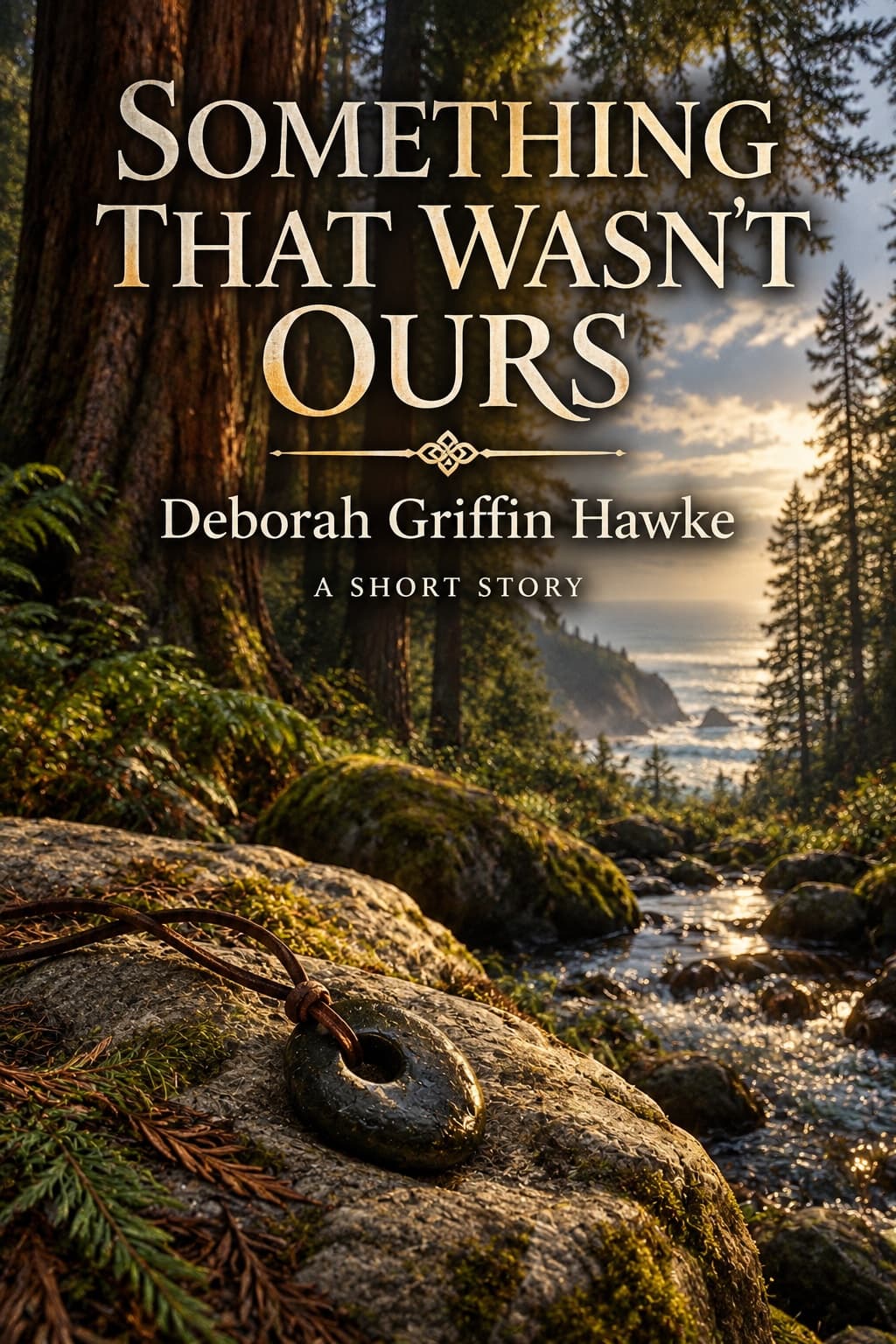
It was a small piece of dark stone, no larger than the end of Winifred's thumb, with a hole worn cleanly through its center.
"May I?" Winifred held out her hand, but Rachel hesitated before taking the cord from around her neck. That interested her almost as much as the stone itself. The girl had described it as something Nick found and gave her because it was pretty, yet she handled it with the reluctance of someone surrendering a possession she had owned for years. When she finally placed it in Winifred's palm, the ring warmed again, not painfully but unmistakably, and Batair moved closer until his whiskers nearly touched her wrist.
The stone was heavier than its size suggested and smooth along most of its surface, although one edge remained rough enough to show that it had once been part of something larger. Winifred turned it over with her thumb. The hole through the center was not drilled, at least not by any tool she recognized; its edges had the softened irregularity of stone worn by water over a very long time. There were no markings, no convenient rune announcing its purpose, and nothing about it that would have attracted her attention if she had found it lying beside an ordinary creek. This creek, however, ran through land where the boundaries had already shown themselves to be unreliable.
"Where exactly did Nick find it?"
Rachel pointed downslope, beyond the tents and the rough collection of vehicles. "There's a place where the creek widens out. We go there sometimes when it's hot. He said it was sitting on top of this big flat rock, like somebody had put it there."
That was considerably less reassuring than finding it in the water. Winifred closed her fingers around the stone for a moment and felt nothing she could have called power, only the peculiar awareness that had been with her since entering the clearing, stronger now but still refusing to resolve itself into anything useful. "And you've worn it ever since?"
"Mostly." Rachel looked at the closed hand with an attention that had begun to make Winifred uncomfortable. "I took it off once."
"When?"
"The night after I heard the voice at the creek. I thought maybe Margaret was right and it had something to do with this, so I left it on the table before I went to bed." She paused, her expression changing as though what came next still embarrassed her. "In the morning it was around my neck again."
Winifred opened her hand and looked at the stone once more. "Did anyone know you'd taken it off?"
"Nick did. He swears he didn't put it back."
That did not eliminate Nick, of course. Young men had been swearing innocence with great conviction since long before there were courts in which to do it, and Winifred saw no reason to grant this one supernatural assistance until it became necessary. Still, the ring remained warm against her finger, and Batair had now seated himself directly on Rachel's foot, which Rachel appeared too distracted to notice.
Winifred handed the cord back but did not immediately release it. "Don't put it on."
Rachel's fingers tightened around the leather. "Why?"
"Because I don't yet know what it is, and until I do, wearing it against your skin seems unnecessarily hospitable."
Rachel gave a nervous laugh but did as she was told, winding the cord around the stone before slipping the whole thing into the pocket of her skirt. Almost immediately Batair stepped off her foot and began washing one paw, which Winifred chose not to interpret too generously. Dogs had an irritating habit of appearing profoundly significant immediately before doing something completely ordinary.
"Nick can show me where he found it," she said. There was no reason to involve Rachel until Winifred had seen the place herself, and several good reasons not to. If something had indeed been calling to the girl, walking her toward the place where the connection began seemed an unnecessarily helpful thing to do. "I'd also like to speak with Margaret before I leave."
Rachel looked surprised. "You're leaving?"
"Eventually. I hadn't planned to take up residence." Winifred glanced toward the collection of tents, bedrolls and improvised shelters scattered beneath the trees. There were perhaps a dozen people living here, maybe more if some were away, and she wondered how many had come and gone since Nick found the stone. Places like this had a fluid population; someone could stay for a night, share a meal and disappear down the highway without anyone thinking to ask a surname. "How long has everyone been here?"
That required more explanation than Rachel seemed to have expected. Nick and Daniel had arrived sometime in June, although not together. The two girls preparing supper had been there for several weeks; one of them had a boyfriend who came and went, and another couple had driven north three days ago in a Volkswagen bus that might or might not return. Rachel herself had been there since July. As she sorted through the inhabitants, Winifred listened less for names than for changes around the time Nick found the stone, but nothing immediately distinguished itself. People arrived, stayed, left and sometimes came back. The camp had no beginning Winifred could identify and apparently no one in charge, which Rachel seemed to regard as one of its virtues.
Nick wandered over before she had finished explaining it. "Are you interrogating her?"
"Not successfully."
"She's very sneaky," Rachel told him, and some of the tension had left her voice. Nick dropped onto the ground beside her and reached automatically for the leather cord when she showed him what she had put in her pocket, but Winifred caught the movement and asked him to leave it there. He looked from Rachel to Winifred, his easy expression changing only slightly.
"Something wrong with it?"
"I don't know yet. Rachel says you found it by the creek."
"Yeah. Want to see where?"
His willingness was useful, although Winifred wasn't sure whether it came from concern for Rachel or the prospect that something genuinely mysterious might be happening in his own backyard. Probably both. She got to her feet, and Batair, having apparently concluded that personal hygiene could wait, rose with her. "Show me."
Nick started down the slope, but Rachel stood as well. "I'm coming."
Winifred had expected that. She considered objecting, then looked at the girl's face and decided there was little point. Rachel had already spent three weeks at the center of whatever was happening; protecting her from a walk to the creek had the flavor of closing the stable door rather late.
"All right. But leave the stone here."
This time Rachel did not ask why.
Rachel went back to the table and tucked the stone beneath a folded sweater, ignoring Daniel's attempt to find out what she was hiding from him, while Nick led Winifred toward a narrow path descending through the redwoods. Batair followed without invitation, as Winifred had known he would, and Rachel caught up with them before they reached the first turn. The sounds of the camp faded surprisingly quickly once they were beneath the trees; even the guitar, which had survived several changes of player without noticeable improvement, disappeared behind the rush of water somewhere below.
The path was steeper than it had looked from above, packed hard in some places and soft with fallen needles in others, and Winifred concentrated on her footing while Nick talked. He had found the stone about three weeks earlier, perhaps a little more. He couldn't remember the exact day, although he remembered that it had been hot enough for everyone to spend most of the afternoon in the creek. "It was just sitting there," he said. "I figured somebody lost it."
"On a rock?"
"Yeah. You'll see it." He turned and walked backward for several steps, apparently trusting the path more than Winifred did. "You think it's some kind of Indian thing?"
Winifred disliked the question for several reasons, not least because people had an unfortunate tendency to classify anything old they found in the American landscape as either Indian or Spanish and then carry it home. She told him she had no idea and asked whether anyone else had touched it before he gave it to Rachel. Nick thought about that, nearly walked into a low branch, and turned around again. Daniel might have handled it, he said, and one of the girls had certainly looked at it, but Rachel was the only person who had worn it. Nick had threaded the leather through the hole himself because she'd been keeping the stone in her pocket and was afraid she'd lose it.
The creek appeared first as brightness through the trees and then as water, broadening below them into a shallow pool where sunlight reached through an opening in the canopy. Several flat stones broke the surface near the far bank, and Nick pointed toward the largest of them. Winifred stopped before stepping out of the trees, not because she saw anything unusual but because the sensation she had been carrying since the camp had changed. The warmth in her ring was gone, replaced by a coolness so distinct that she rubbed her thumb across the metal before realizing what she was doing.
Nick had continued toward the water, but Rachel remained beside her. "This is where I heard it the first time."
Winifred looked at the pool again, taking in the flat rock, the water curling around it and the dense growth along the opposite bank. Nothing moved there except leaves disturbed by a breeze she could now feel against her face, yet the place did not feel empty. It felt occupied in the way a room sometimes did when one entered and discovered that a conversation had stopped a moment too late.
"Show me exactly where you were," she said.
Rachel led her around the edge of the pool to a patch of gravel where the bank sloped gently enough to reach the water without climbing. Someone had left a cake of soap on a stone above the waterline, softened by use and weather into a pale shapeless lump, and a faded towel hung from the branch of a young alder nearby. "I was here. I had my clothes spread out on those rocks to dry."
Winifred could see why the camp used the place. Upstream, the creek came through a narrow channel crowded with ferns and overhanging branches before spilling across a shelf of stone into the pool. The water was clear enough for her to see rounded pebbles on the bottom and the quick movements of something small beneath the shadow of the bank. On the opposite side, redwoods rose beyond a dense understory of huckleberry and fern, their trunks so large and evenly spaced that the younger trees between them seemed almost temporary. Fallen branches had collected against the roots of one tree where the bank had been eaten away, leaving a dark hollow beneath it, while farther downstream the pool narrowed again and disappeared around a bend screened by willow.
Nick had already taken off his shoes and was crossing toward the flat rock, stepping from one exposed stone to another until the last gap forced him ankle-deep into the water. Winifred stayed where she was. The rock itself was broad enough for two people to sit comfortably and had been bleached almost white where the sun reached it, except for a darker depression near one edge where rainwater or the creek at a higher level had worn a shallow basin into the surface.
"Right there," Nick said, pointing to it. "That's where it was."
Winifred walked upstream first. She wanted to know what fed the pool and whether there was anything about the terrain that Nick had overlooked simply because he was accustomed to it. The creek narrowed rapidly above the little fall, forcing its way between rocks furred with moss before dividing briefly around the exposed roots of a redwood. There were footprints in the damp ground, cigarette ends, a bottle cap and, caught beneath a fern, the silver paper from a stick of chewing gum. Whatever else this place might be, human beings had not approached it with reverence.
She crossed back below the pool where the water was shallower, accepting Nick's hand over the slickest stones, and examined the opposite bank. Here the ground rose more sharply and the undergrowth thickened within a few yards, but she found the remains of an old path beneath it, little more than a shallow line through the duff. It did not lead toward the camp. Instead, it followed the creek downstream for a short distance before turning away from the water and vanishing among the redwoods.
"Does anyone use this?"
Nick had followed her. "That? I don't think so. There's nothing back there."
"How do you know?"
He considered that and grinned. "Because we went back there to see if there was anything."
Rachel, still on the other bank, laughed. "Of course you did."
Winifred smiled despite herself and crouched beside the faint path. Beneath the redwood needles the soil was darker, and when she brushed some of them aside she found stones set close together along one edge, too regular to have collected there naturally. Moss had covered most of them, and roots had pushed two out of line, but the arrangement continued far enough into the trees that she could follow it with her eyes once she knew what she was looking for. The path was older than the camp by a considerable margin and probably older than Nick, which was not saying much, but age alone did not make it supernatural. People had been moving through these woods long before any of the young people above them had decided they had discovered a private wilderness.
She straightened and looked back across the pool. From this side the flat rock appeared almost deliberately placed between the two banks, although Winifred knew better than to trust appearances where water and stone were concerned. What interested her more was the relationship between the old path and the creek: the path did not simply pass nearby but curved toward the pool before continuing downstream, bringing anyone who followed it within a few yards of the rock where Nick had found the stone.
She followed the old path downstream, moving slowly enough to distinguish its remains from the accidents of roots and fallen timber. Nick came with her while Rachel stayed near the pool, and for the first twenty yards or so the line of stones continued intermittently beneath the moss. Then the path climbed away from the creek and widened slightly, passing between two redwoods before reaching a patch of comparatively open ground where very little grew except sorrel and fern.
Winifred stopped there and turned to look back. From this distance she could no longer see the pool, although she could hear the water, and the camp might have been miles away rather than a short climb up the slope. The ground beneath the redwoods was uneven with roots, but near the center of the opening stood three stones that did not belong to the surrounding geology. They were not large—Nick could probably have lifted any one of them if sufficiently motivated—but each had been set upright, and although two now leaned at different angles, the third remained nearly vertical. Lichen covered their upper surfaces, with moss thick around the bases where years of needles had accumulated.
"Those were here," Nick said.
"I assumed you hadn't put them up."
He laughed. "I mean when we came down here before. We figured somebody made a fire pit or something."
There was evidence that somebody had. Blackened stones lay in a rough circle several feet away, along with the remains of charred wood and a rusting tin can, but Winifred doubted the upright stones had anything to do with it. She walked around them without touching them and found another half buried in the ground several yards farther on. Whatever arrangement they might once have formed had been disturbed too badly for her to reconstruct it by sight, and she resisted the urge to make a pattern simply because she wanted one to be there.
"How far did you follow the path?"
"Not much farther. Daniel thought there might've been a cabin back here, but we never found one." Nick pushed his hair away from his face and looked around as though the missing cabin might have appeared since his last visit. "There's some more rocks, then it gets really overgrown."
By the time they started back, Winifred was beginning to think the stone Nick had picked up had not been lost. She asked him to tell her again exactly how he had found it. Nick was patient about repeating himself, although the story acquired details now that he was standing where they had happened. There had been six or seven of them at the pool that afternoon, swimming and lying on the rocks until the sun moved behind the trees. He had noticed the stone when he went back for his shirt. It had been in the shallow depression on top of the flat rock, dry despite the splashing that had soaked nearly everything around it, and he remembered picking it up because the hole through the middle made him think someone must have made it deliberately.
"Did you see it when you got there?"
Nick shook his head. "I don't think so. But I wasn't looking at the rock."
"Was anyone else?"
"Probably not." He glanced sideways at her. "You think somebody put it there while we were swimming?"
"I think it was there when you picked it up."
He laughed, and Winifred allowed him that. She was not going to fill the gaps in what she knew merely to satisfy his curiosity, particularly when Nick seemed quite capable of filling them himself. By the time they reached the pool again he had proposed an Indian burial ground, a Spanish mission no historian had discovered and, with considerably more enthusiasm, witches. Rachel was sitting on the bank with her shoes off and her feet in the water, listening to his last theory as they approached.
"Witches?" she said. "Really?"
"She won't tell me anything."
"Because I don't know anything," Winifred said. "It's a distinction worth preserving."
Rachel drew her feet from the water and reached for her shoes. Winifred asked her to wait a moment and went instead to the flat rock. Nick showed her where the stone had lain, in the shallow basin near the edge, and she crouched to examine the surface more closely. The depression held a scatter of redwood needles and a little grit now, but when she cleared them away she found several narrow grooves in the stone beneath, so worn that they disappeared when viewed from some angles and returned when the light caught them from another. They might have been scratches made by waterborne debris or by generations of people using the rock for purposes entirely unrelated to the old path. One curved around the edge of the basin and another crossed it, continuing beneath a patch of lichen.
Winifred traced neither. She had learned that touching unfamiliar things simply because one had found them was a habit best left to people like Nick.
She stepped back into the creek and walked around the rock, studying it from the water. Near its base, where the current had undercut one side, something pale showed between the stone and the gravel. She bent closer and saw several small objects wedged deep in the crevice: a smooth white pebble, what might have been a shell, and two dark shapes too obscured by silt to identify. There was no way to know how long they had been there. Children collected things and tucked them into holes; water carried debris into improbable places; people had been dropping objects into streams for as long as there had been streams.
"What is it?" Rachel asked.
"Possibly nothing." Winifred straightened carefully on the slippery creek bed. "Which is becoming an increasingly crowded category."
Nick came into the water beside her and bent immediately toward the crevice. Winifred caught the back of his shirt before he could reach into it.
"I wouldn't."
He looked over his shoulder. "Why?"
"Because you've already brought one thing home from here, and I'd prefer not to conduct the same experiment twice."
Nick stood, grinning as though he had been caught doing something mildly disreputable rather than potentially foolish, but he left the crevice alone. Winifred looked once more toward the old path on the opposite bank. She still had no idea whether the objects beneath the rock had been placed there or merely accumulated, but she was now reasonably certain of one thing: before she decided what Nick had found, she needed to know who had used this place before Nick and his friends arrived.
The climb back to camp seemed steeper than the descent had been, which Winifred regarded as one of nature's less amusing consistencies. Nick went ahead with the careless balance of someone whose knees had not yet begun sending occasional reminders of their existence, while Rachel stayed closer to Winifred and Batair brought up the rear. He had declined to accompany them beyond the pool and had apparently spent the interval doing whatever cats did when they wished to imply that human investigations were beneath them.
By the time they reached the clearing, supper had progressed from preparation to something approaching a communal event. Someone had produced another pot, the disputed rice had been supplemented with beans and vegetables, and several people Winifred had not seen earlier were sitting around the table or on the ground nearby. The smell was better than she had expected. So was the bread being passed from hand to hand, although Daniel was cutting it with a knife Winifred suspected had recently been used for purposes other than food.
Rachel retrieved the stone from beneath her sweater and, after a moment's hesitation, put it into a small wooden box among her belongings rather than back into her pocket. Winifred noticed but said nothing. She was more interested in finding Margaret, who had not returned to the clearing while they were gone.
"She's probably at her place," Rachel said. "It's not far."
That depended, Winifred had discovered since arriving in California, upon who was defining far. Margaret's place turned out to be beyond the fork Winifred had passed earlier, perhaps half a mile back along the road, and Nick offered to take her there after supper. Winifred declined the escort. She had found Margaret Bell before and was reasonably confident she could accomplish it again, particularly now that she knew which fork not to take.
Daniel overheard enough of the conversation to ask whether she was leaving before they ate. When Winifred said she intended to speak with Margaret first, he looked genuinely disappointed and insisted there would still be food when she returned. It was an unexpectedly domestic concern from a young man who had spent much of the afternoon barefoot and apparently unconcerned about the ownership of rice, and she promised to consider it.
She found Margaret's house with considerably less difficulty than she had found the camp. It stood well back from the road behind a stand of cypress, a small, weathered cottage with a porch running across the front and a vegetable garden that had been allowed to negotiate its own boundaries. Herbs grew in pots along the steps, some culinary and some less likely to find their way into supper, and several bunches hung drying beneath the porch roof. Winifred recognized lavender and rosemary before she reached the gate and something sharper beneath them that she could not immediately identify.
Margaret opened the screen door before Winifred knocked. She was a small woman in her late sixties, perhaps older, with iron-gray hair braided down her back and the same direct blue eyes Winifred remembered from their last meeting. Time had narrowed her face and bent her slightly at the shoulders, but otherwise she seemed irritatingly well preserved.
"You took your time," Margaret said.
"I got lost."
"I know."
Winifred looked at her.
Margaret smiled and held the door open. "Come in. I've made tea."
Winifred stepped past her into the house, reflecting that there were several possible explanations for Margaret knowing she had taken the wrong road and that she disliked most of them.
Margaret's kitchen was much as Winifred remembered it, crowded without being untidy, with open shelves of mismatched crockery and a wooden table scarred by years of knives, hot pans and people who had apparently never felt the need for coasters. The tea was already poured. Winifred accepted a cup and sat while Margaret settled opposite her, waiting until Winifred had tasted it before asking what she had found.
"A young woman wearing a stone that may or may not belong to her, an old path beside the creek, several stones somebody went to the trouble of standing upright, and what looks very much like a place where people left small offerings." Winifred set down her cup. "You might have mentioned some of that."
"I wanted you to see it before I told you what I thought."
"How considerate."
Margaret ignored the sarcasm. She had known about the path for years, although not who had made it. The property had changed hands repeatedly before the present owner stopped caring who camped on it, and Margaret had heard several versions of its history from people who were confident despite disagreeing with one another. There had supposedly been a cabin near the creek sometime around the turn of the century, and before that a family who grazed animals farther inland. None of it explained the stones, and Margaret had been careful not to manufacture an explanation simply because one was missing.
"The little things under the rock?" Winifred asked.
Margaret nodded. "I've seen them."
"And left them there."
"Of course I left them there."
That improved Winifred's opinion of her considerably. She described the stone Nick had found, including the worn hole through its center and Rachel's insistence that after removing it one night she had awakened with it around her neck again. Margaret listened without interrupting, although her mouth tightened at that last detail.
"I told her not to wear it until you came."
"She didn't listen."
"She's twenty."
"That isn't an explanation. It's a diagnosis."
Margaret laughed, then reached for the teapot. "Do you remember what my grandmother used to call stones with natural holes?"
Winifred did. There were dozens of names for them, most accompanied by dozens of claims: hag stones, adder stones, witch stones, seeing stones. Hang one near a door to keep away nightmares; look through one to see what ordinarily remained hidden; carry one for protection from things that resented being seen. Human beings had rarely encountered an unusual stone without assigning it several contradictory occupations.
"My grandmother said they were doors," Margaret continued, "but not in the way people think. You didn't go through them. Something could notice you through them."
Winifred looked at her over the rim of the cup. "That would have been useful information before Rachel put one around her neck."
"I didn't know what Nick had found until Rachel described it, and by then she'd been wearing it for weeks. That's when I sent for you."
There was enough sense in that to prevent an argument. Winifred thought again of the stone lying dry in the shallow basin on the rock and of the objects caught beneath it. If the place had once been used for offerings, Nick had not merely found something interesting beside a creek. He had removed something from a place where things were left deliberately, then given it to Rachel, who had worn it against her skin as though claiming it.
"Suppose it wasn't an offering," Winifred said. "Suppose it was part of the invitation."
Margaret's hand stopped over the teapot.
Winifred did not yet know whether she believed it herself, but the idea accounted for more than a stolen trinket did. The missing belongings had begun only after Rachel wore the stone; the voice had followed later, growing more intimate without ever acquiring an identity she could remember. Whatever was reaching for her might not be trying to frighten her at all. From its perspective, it might simply be waiting for Rachel to finish something she had unknowingly begun.
Margaret was quiet for a moment before asking, "What do you intend to do?"
"Put it back."
"And Rachel?"
"She comes with me." Winifred finished her tea and set the cup down. "If she accepted the invitation, however accidentally, I doubt returning the stone without her will be sufficient. She needs to make it clear she isn't coming."
Margaret regarded her for a long moment. "You make it sound very simple."
"No. I make it sound polite. With the old ones, those are rarely the same thing."
By the time Winifred returned to the camp, the light beneath the redwoods had begun to change. Supper was underway, and for a few minutes she allowed herself to be given a bowl of rice, beans and vegetables while Rachel watched her from across the table with increasing impatience. Nick watched too, although his interest seemed less anxious and more hopeful that Winifred was about to confirm at least one of his theories.
She disappointed him. When she had eaten enough to satisfy Daniel, who apparently regarded an unfinished bowl as a personal criticism, she asked Rachel to get the stone and come with her. Nick immediately stood as well, but Winifred told him that this time she wanted Rachel alone. He looked ready to argue until Rachel touched his arm and said she'd be fine, with more confidence than Winifred suspected she felt.
The stone remained where Rachel had left it. She carried the wooden box rather than touching it directly, and they started down the path with Batair following close behind. The woods were quieter now, although not silent. Birds moved high in the branches, something small rustled through the undergrowth, and the creek grew steadily louder as they descended. The air had cooled enough that Rachel rubbed her bare arms once or twice, but she did not complain or ask what Winifred intended to do until they reached the pool.
"What if putting it back doesn't work?"
"Then we'll have learned something."
Rachel gave her a look that suggested this was not especially comforting.
"I don't know what will happen," Winifred said. "Anyone who tells you otherwise in a situation like this is either a fool or trying to sell you something. What I do know is that you took nothing deliberately, and whatever understanding exists here was made without your knowledge. That matters."
"To them?"
"It should."
The pool looked different in the failing light, its surface reflecting pieces of sky between the trees while the far bank had already fallen into shadow. Winifred stepped onto the flat rock and held out her hand for the box. Rachel gave it to her, and when Winifred lifted the lid the stone lay inside with the leather cord wrapped around it, ordinary enough that she found herself irritated by the amount of trouble such a small object had caused.
She removed the cord first. It belonged to Nick and Rachel, not to whatever arrangement had existed here before them, and leaving it behind would only confuse matters. Then she tipped the stone into her palm. The coolness returned beneath her ring almost at once, stronger than it had been earlier, and this time she could feel something else beneath it, a faint vibration that might have been the water moving through the rock beneath her feet.
Rachel had gone very still on the bank. "Do you hear that?"
Winifred listened. The creek moved around the stone as it had all afternoon, and somewhere upstream water slipped continuously over the little shelf into the pool. At first she heard nothing beyond it, but gradually another sound separated itself from the water, too indistinct to be a word and too deliberate to be dismissed as part of the current.
"Is that the voice?"
Rachel nodded. "It's saying my name."
Winifred heard no name. What reached her was closer to the cadence of speech than speech itself, shaped just enough that the mind wanted to finish what the ear could not. That, more than anything Rachel had told her, convinced Winifred that the girl had not been imagining her experience. Whatever waited at the edge of this place did not know Rachel's voice, Nick's or anyone else's. It had learned only how to make her hear what she expected to hear.
"Come here," Winifred said, and Rachel stepped carefully into the water until she could take Winifred's offered hand and climb onto the rock. The sound changed as she did, not growing louder exactly, but becoming easier to attend to, and Rachel's fingers tightened around hers.
Winifred placed the stone in the shallow basin where Nick had found it. For several seconds nothing happened. Water continued around them, the last sunlight remained caught high in the redwoods, and Batair sat on the bank with his tail curled neatly around his feet.
"Tell them," Winifred said.
Rachel looked at her. "Tell them what?"
"The truth. You didn't know what the stone was. You didn't know taking it meant anything, and you don't accept whatever was being offered."
Rachel turned toward the far bank, looking self-conscious at first, then increasingly serious as she spoke. She apologized for taking the stone, explained that Nick had found it and given it to her, and said that neither of them had meant to steal anything. When she reached the part Winifred had told her mattered, she hesitated long enough that the almost-voice seemed to gather around the sound of the creek.
"I don't know what you wanted me to do," Rachel said, "but I'm not coming with you. I never said I would."
Nothing answered in words. The water at the edge of the rock lifted in a brief ripple although no wind had reached the pool, and the cool pressure around Winifred's ring eased so gradually that she noticed its absence only after it was gone. Across the creek, something moved behind the redwoods—not a figure she could describe afterward, nor even a shape she was certain she had seen, but a shift of darkness between one tree and the next that continued farther into the woods until there was nothing left for her eyes to follow.
Rachel let out the breath she had been holding. "Is that it?"
Winifred looked down at the stone. It remained in the basin, wet now from Rachel's splashing, indistinguishable from any number of objects a person might pick up because it was pretty.
"I think," she said, "we should give them a little time to consider your answer."
They waited until the light had nearly gone. Nothing else moved across the creek, and the almost-voice did not return. Rachel eventually sat beside Winifred on the rock, close enough that their shoulders touched, while Batair grew tired of supervising from the bank and began making his displeasure known in short, increasingly pointed complaints.
"Do you think they'll leave me alone now?" Rachel asked.
"I think you've made yourself clear. I also think you should stay away from this part of the creek for a while, and if Nick finds anything else that appears to have been deliberately placed somewhere, encourage him to admire it without bringing it home."
Rachel laughed. "That's going to be harder."
"I suspected it might be."
They climbed back toward camp in almost complete darkness, Rachel carrying the empty wooden box and Winifred relying more than she liked on the flashlight Margaret had insisted she take. The clearing announced itself well before they reached it. Someone had built up the fire, the guitar had returned with a different song and no noticeable increase in skill, and several voices were arguing cheerfully about something Winifred could not follow. Nick spotted Rachel first and came toward them, stopping when he saw the empty box in her hands.
"It's back where you found it," Rachel told him.
He looked disappointed. "So what was it?"
Rachel glanced at Winifred before answering. "Something that wasn't ours."
Winifred could not have improved on that. She retrieved her bag, declined Daniel's offer of more food and accepted a piece of bread for the road instead, largely because refusing it seemed likely to provoke a discussion. Nick walked her to the car, apologizing again for sending her down the wrong road when she arrived, although Winifred suspected he was not especially sorry. Rachel followed and thanked her with an awkwardness Winifred found more touching than she intended to show.
"Go see Margaret tomorrow," she told her. "And if you hear the voice again, don't follow it anywhere."
"I won't."
Winifred opened the car door, but Rachel remained beside her. "Were they trying to hurt me?"
It was the question Winifred had expected sooner or later, and she wished she had a better answer. "I don't know. We tend to assume that anything dangerous intends harm, but that's a very human way of looking at things. The sea can drown you without disliking you at all." She glanced toward the redwoods, their upper branches invisible now against the night. "I think something noticed you. I think you answered without knowing you had been asked a question."
Rachel considered that before nodding. It was not reassurance, but Winifred had never thought reassurance useful when it required lying.
Batair jumped into the passenger seat as soon as she opened his door, turned twice and settled himself with his back toward her. Winifred started the engine and waited while Nick and Rachel moved out of the way. As she pulled onto the road, she caught one last glimpse of the camp in the mirror: firelight among the trees, young people moving through it, someone lifting an arm in farewell. Then the road curved and they were gone.
At Margaret's fork she slowed, although there was no reason to stop. The old woman would hear the story tomorrow from Rachel and would undoubtedly find some detail Winifred had overlooked, which she would save until the next time they met merely to be irritating. Winifred smiled and drove on.
Several miles later, Batair lifted his head and looked toward the dark woods beyond the passenger window. Winifred felt nothing from the ring and heard nothing except the engine and the tires against the road, but she looked too.
For an instant there was a pale flicker among the trees, keeping pace with the car where no path ran beside them. It disappeared almost as soon as she noticed it, and Batair lowered his head again.
Winifred kept driving. There were some invitations it was wiser not to investigate.
The end.
Comments
No comments yet. Yours can be the first.
About the author

Deborah Griffin Hawke
I write fantasy about women who discover that the stories their grandmothers told them may not have been stories after all. My books blend folklore, inherited magic, family secrets, and contemporary life—with women who have accumulated enough years and experience to know that discovering magic doesn't make the ordinary complications of life disappear. Before turning my attention to fiction, I spent much of my career in higher education, where I learned that people are considerably more complicated than any character a novelist could invent. That probably explains why I'm as interested in what magic does to people and relationships as I am in the magic itself. I write as Deborah Griffin Hawke. The Enchanted Legacy of Elizabeth Marchand begins my Lore of the Grandmothers series, followed by The Secrets of the Thistle & Shield. If you like folklore that wanders into the present day, old family mysteries, female friendships, a little danger, and the occasional small dog who may be considerably more than he appears, you'll probably feel at home in my books.
More about Deborah Griffin Hawke →